

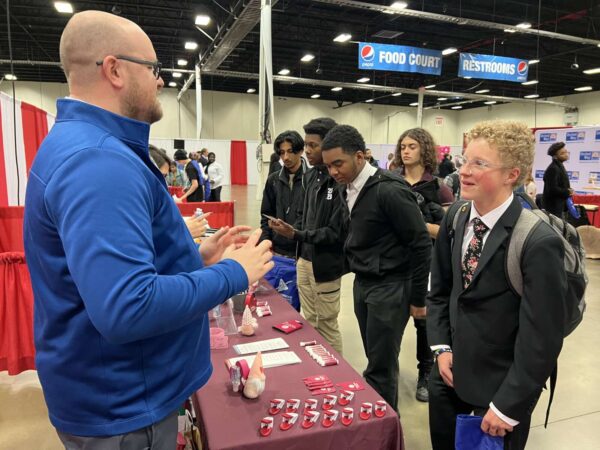
CTE, or work-based learning, as it’s also known, is a hot topic in the region as public school divisions aim to place students into internships and externships at companies in the region. The practice gained steam in 2018, but it was derailed by government-ordered school building closures brought on by the coronavirus pandemic.
In Fredericksburg today, more than 500 students were invited to attend an internship expo at the city’s event center, where they could interview representatives from prospective companies looking to attract new talent. Regional school divisions, including Stafford County Public Schools and Mary Washington University, participated in the second-annual event organized by the Fredericksburg Regional Chamber of Commerce.
Today students attended the Fredericksburg Expo Intern Fair where they got a chance to interact with different business in the surrounding communities!@SCPSchools @WestleytheWolv1 @ThomasTaylorEdD pic.twitter.com/QV1EWtWqZ9
— NorthNation (@NSHSNorthNation) February 14, 2023
Meanwhile, the Manassas City Public Schools Work-based Learning office invited more than 50 people to Osbourn High School for a workshop on its program, which aims to place more than 500 seniors with companies by next year as part of a newly-expanded, ambitious internship program that will require students to obtain 280 hours of work to receive credit for the work-based learning course.
Thank you to the over 40 businesses that registered and attended our 1st ever Work-Based Learning Business Information Session. Businesses learned about our WBL program by viewing WBL options, listening to a panel discussion, and touring our CTE Programs. #mcpswbl #wbl4all pic.twitter.com/y7DitujVso
— Manassas City Public Schools WBL (@ManassasCityWBL) February 9, 2023
In Prince William County, public schools Superintendent Dr. LaTanya McDade said students must graduate with six CTE dual enrollment credits by 2025. More in McDade’s statement:
February is also Career and Technical Education (CTE) month. CTE programs are critical in preparing our students for employment in fast-growing fields, such as computer programming, engineering, health science, and skilled trades. I invite you to view a video featuring one of our exemplary CTE programs at Osbourn Park High School.
Commitment 1 of our Strategic Plan, Learning and Achievement for All, includes the goal of having at least 1,000 CTE students graduate high school with a minimum of six CTE dual enrollment credits by 2025. We are also proud to feature our CTE programs, teachers, and students, including these recent examples that I am excited to share:
-
CTE has registered 106 registered work-based learning partnerships.
Fifteen students are engaging in a paid registered youth apprenticeship with My Secure Kids.
-
Forty students will be engaged in a paid internship with PWCS, funded by the Advancing Computer Science Education (ACSE) grant.
-
Ninety students will be attending George Mason University (GMU) for gaming classes.
-
GMU is hiring 12 student interns to support the gaming classes.
