

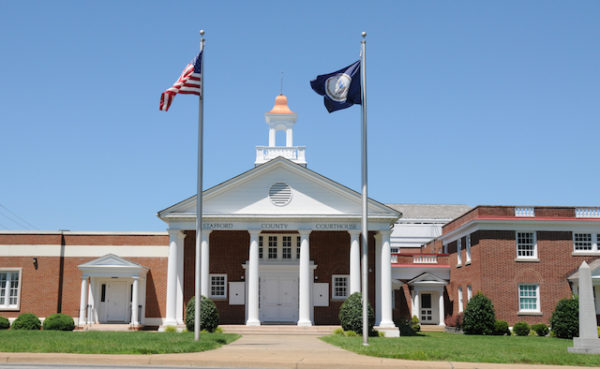
Stafford County is moving ahead with its plan to transform its courthouse neighborhood into a smart city of the future.
The Stafford County Board of Supervisors on Tuesday approved a memorandum of understanding (MOU) to allow for the development of smart city technology for the Stafford County Government Center. This will designate the intersection of Route 1 and Courthouse Road as the Downtown area of Stafford.
It will also be a smart city “testbed” for Virginia, where new technologies, like enhanced 5G wireless connectivity for public-safety, educational programs, transportation, tourism will be tested, county officials told elected leaders.
The County had been granted $100,000 by the Virginia Center of Innovative Technology (CIT), a quasi-governmental agency, to study the possibility of becoming such a hub. OST Inc., a Washington D.C. based consulting firm that conducted a study of the concept, was tasked with creating a model for the testbed along with technical specifications and to secure private partners for the development of the technologies.
CIT has committed over $500,000 in funds to the project and continues to seek further funding and partnerships through 2021, officials said.
County leaders hope that this cash infusion will help with the development and appeal of “Downtown Stafford” by attracting businesses and new younger residents to the area.
In February, county staff told elected leaders the development would be modeled on Rockville Town Square, in Rockville, Md. Nearly 1,000 new apartment homes and street-level retail shops would be needed to accomplish the development goal.
However, not everyone is convinced a “smart city” in Stafford is a good idea.
They’re not the only ones with reservations, during a recent meeting with the Board of Supervisors a comment was made via e-mail by Stafford resident Dana Brown:
“Some of it sounds exciting but much of it sounds like a huge invasion of privacy. Several uses are listed and many have the non-specific caveat word etc. used widely. Do you even know what you’re authorizing?”
Brown goes on to list concerns such as the smart poles that will be equipped to track cars, concerns about health-tracking technologies, parking issues for senior citizens who may not be capable of using smartphones for the task, and the vulnerabilities to potential hacking issues and power outages.
“Please do not go forward with the proposal just to be “cool and innovative” and to not sacrifice privacy to be guinea pigs for the state,” asked Brown at the end of her e-mail statement.
Brown’s concerns echo those of some sitting elected supervisors who first heard about the smart city plan in February.
“If I’m [a 25-year-old], I’m moving to Arlington and Alexandria and getting a roommate. I’m not moving to Stafford,” said Rock Hill District Supervisor Crystal Vanuch, during an annual retreat meeting of the Board of Supervisors held at Airlie Conference Center near Warrenton.
“I’m very skeptical about this because I know my [constituents] aren’t going to drive up there,” added George Washington District Supervisor Tom Coen.
