

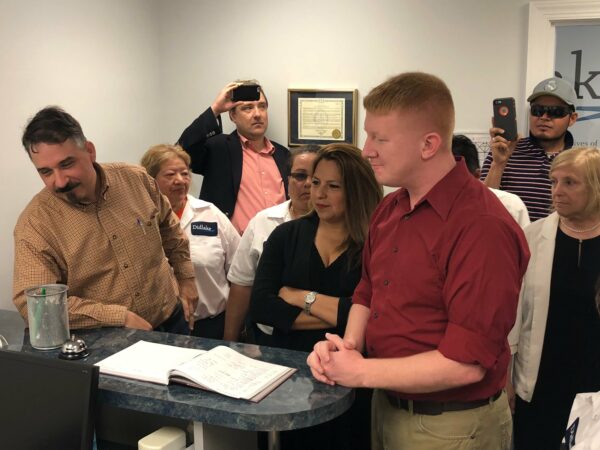
MANASSAS — Workers who’ve been on strike for three weeks against Didlake Inc., including several with disabilities, took their grievances to the company’s Manassas headquarters Thursday morning with the support of local elected officials.
The workers voted in April to form a union, culminating a yearlong effort aimed at improving their pay and health-care benefits. But Didlake has refused to recognize those efforts while awaiting a ruling from the National Labor Relations Board, stemming from the company’s appeal of a decision that favored the workers.
The workers walked off their jobs May 25 at the Army National Guard Readiness Center in Arlington, where they clean the buildings under a federal contract. The workers previously protested outside the facility.
This week, a group of about 20 people gathered outside the corporate office of Didlake, a nonprofit agency that provides training and rehabilitative services for people with developmental and other disabilities in Virginia, Maryland and Washington. They wanted to talk with the company’s CEO, Donna Hollis.
“All you are asking for is respect,” said Virginia Diamond, president of the Northern Virginia chapter of the AFL-CIO.
“And this is how they treat us,” replied Samantha Ulloa, one of the striking workers who have been seeking union representation since 2015. “We should at least be able to talk to them.”
They were joined by local labor supporters as well as with a pair of elected officials — state Delegates Elizabeth Guzman Lee Carter, both Democrats who represent portions of Prince William County and Manassas.
The issue centers around the question of whether workers who are disabled — and whose jobs therefore are considered “rehabilitative” — are entitled to the same labor protections as nondisabled workers.
Didlake issued a statement citing previous NLRB decisions that found “collective bargaining could constitute a harmful intrusion on the rehabilitative purpose” of programs like theirs.
The current stalemate originated with an October 2016 NLRB ruling that Didlake’s program at the Arlington facility is essentially commercial rather than rehabilitative, so it doesn’t meet the standards of those previous decisions. That ruling allowed the union election to proceed. Didlake appealed, and the outcome is pending.
“Didlake is not anti-union,” Hollis said in a written statement. “We support the rights of people with disabilities to organize and join a union. We are highly concerned that unionization for people with disabilities participating in the AbilityOne program will threaten the rehabilitative services afforded to them under the program.”
The federal AbilityOne program is aimed at providing employment for people with disabilities.
The workers believe Didlake’s appeal to the NLRB amounts to a delay tactic because it could be weeks or months before the federal board, which has been mired in infighting and budget constraints, issues a ruling in the case. They pressed company officials to schedule a meeting where they could talk about their concerns.
“We’ve got right on our side, and we’ve got the law on our side,” said Carter. “The company is trying to delay, hoping the people will give up.”
