

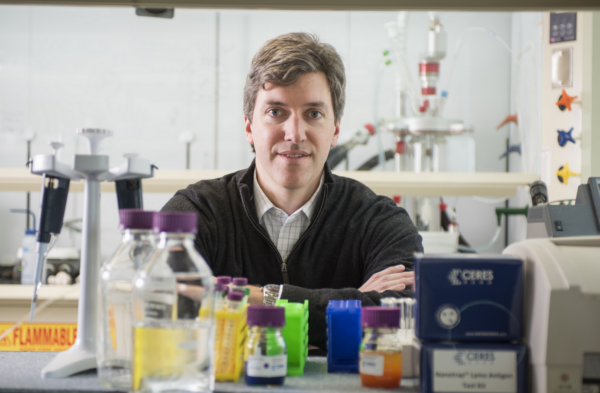
Life, health, and biotechnology sciences are getting a local hand up, thanks to the Prince William Science Accelerator. Ross Dunlap, CEO of Ceres Nanosciences, Inc., can tell you how it has been beneficial to his organization.
Ceres is the first company to “graduate” from the accelerator, which Dunlap says, “provides wet-lab space to life sciences companies of all sizes – from the earliest stage start-ups to emerging life sciences companies.”
Ceres is the developer of Nanotrap Technology, a sample processing tool for a wide range of diagnostic applications and sample handling. Their stated mission is to address critical diagnostic needs and provide better patient outcomes.
“The accelerator provided much needed wet lab space in an area where there are few options,” said Dunlap. “Without these facilities, our company would not have been able to pursue a number of strategic development projects.”
Dunlap said because of the accelerator, “Ceres was able to conduct several key development projects and begin scaling up its manufacturing capabilities for its Nanotrap particle technology.”
In a press release announcing Ceres’ graduation and expansion, the company described the technology as providing “enhanced sample processing capabilities to new and existing diagnostic tests for some of the most challenging diseases and conditions, such as Lyme disease, respiratory diseases, emerging infectious diseases and cancer detection, as well as for improved health and wellness monitoring.”
The Nanotrap technology caught the eye of several key agencies. In February 2017, Ceres received a $750K award to adapt Nanotrap to address Zika and other emerging pathogens.
According to a press release, the Ceres development program was “funded by the Defense Advanced Research Projects Agency (DARPA) of the US Department of Defense, to use Ceres’ Nanotrap particle technology to commercialize sample processing tools for improved detection of Zika and other emerging pathogens from non-invasively collected urine and saliva specimens.”
The technology itself has local roots, as the press release explains.
“The Nanotrap particle technology was invented at George Mason University under funding from the National Institutes of Health (NIH) for biomarker discovery applications, and currently is being developed into commercial products by Ceres with support from NIH, Defense Advanced Research Projects Agency (DARPA), the Bill and Melinda Gates Foundation, the Department of Homeland Security (DHS), and the Commonwealth of Virginia.”
But it’s not just the wet lab space that helped make all this happen.
“The county is providing $50K of economic development funds to support the renovation of the new space that will allow new partnerships and collaborations with industry partners,” Dunlap said.
The accelerator, Dunlap said, is “the only site in [Northern Virginia] that provides multiple units and options for wet-lab space to early-stage life sciences companies.”
Located at Innovation Park in Prince William County, a hub of science and technology anchored by George Mason University’s Prince William Campus, the Prince William Science Accelerator is touted by the county as “a premier life sciences incubation facility, which features nine fully built out, commercially available wet labs – the only commercially available wet lab space in Northern Virginia.”
Dunlap said after graduating this past December, Ceres “moved into a larger space nearby, about [a mile] away across from Mason’s campus. The space is about 10,000 square feet of custom configured wet labs space for manufacturing.”
