
STAFFORD — Stafford County leaders on Tuesday slashed by 60% the number of acres on which housing developers could build “cluster” developments.
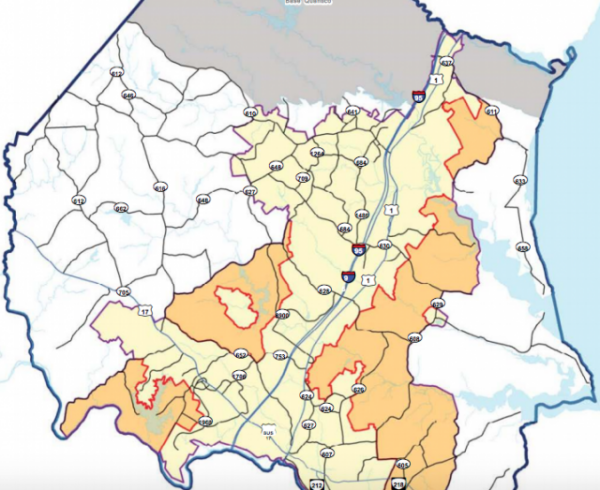
The Board of Supervisors voted to restrict all new cluster developments to the county’s urban service area, meaning that 80% all new development in the county would occur on a tract of land largely located along Interstate 95, bounded roughly to the west by Kellogg Mill, Mountain View, and Joshua roads to the west, and Brooke Road to the east.
The move reduces the amount of available land on which to build cluster developments to 40% of the undeveloped land in the county, the state-required minimum. Now there are about 19,000 acres of the county’s 177,000 total acres on which cluster developments may be built.
Large portions of rural land in the county’s Rock Hill, Hartwood in the west, and Aquia districts in the east are no longer eligible for cluster development.
The Board voted to send its recommendation to reduce the number of developable acres to the county’s planning commission for it to initiates a change to the county’s comprehensive plan by late May to reflect the new policy.
Much of the land developers can now place cluster developments on has already been developed, especially along the Route 610 and Route 1 corridors. With the exception of the Widewater District, bounded by Routes 1 and 610, the Prince William County line, and the Potomac River.
Widewater District Supervisor Jack Cavalier was the only Supervisor to vote against the plan, saying his district — now nearly all of it included in the development area — is the one most impacted by the change.
“The unfairness is unbelievable,” said Cavalier.
The move comes after weeks of discussion among elected officials that want to limit the amount of new development in the county. Officials said that cluster developments — designed to cluster homes in one section of a property to preserve open space — were negatively impacting the county’s countryside by with homes clustered near roadways and the preserved space out of view by the public.
Officials also said the use of community septic drain fields allowed for the construction of more homes that should be permitted in the rural area, and that land preserved by developers was property slated for stormwater retention ponds and utility easements.
Developers said they were never given an opportunity to work with county officials to create a new cluster ordinance. They also maintain cluster developments not only save them money on development costs since only a portion of a property is developed, but they also say cluster developments require the construction of fewer streets to be maintained with tax dollars.
The vote was made during the Board of Supervisors afternoon session, prior to a public hearing scheduled at 7 p.m. where the public — largely developers — were expected to speak on the Board’s threat to repeal and eventually replace the county’s cluster ordinance.
If the Board repeals the ordinance and does not have another in place, the county would be in violation of state law which requires the locality to have a cluster ordinance in place.
After the vote, Cavalier questioned the need for holding the 7 p.m. public hearing.