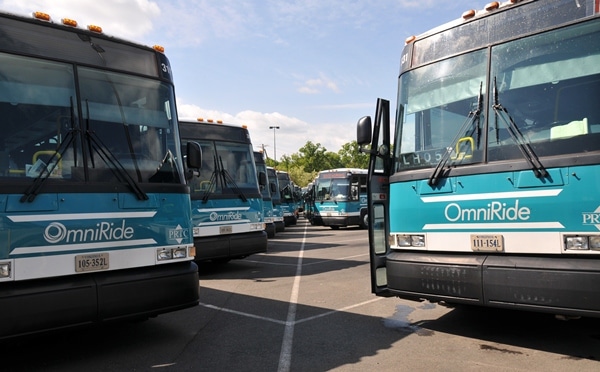
Some relief for cash-strapped OmniRide could come in the form of legislation in Richmond.
A new bill by Sen. Frank Wagner (Norfolk, Virginia Beach) would set the gas tax “floor” at February 2013 rates. That means OmniRide’s parent agency Potomac and Rappahannock Transportation Commission would get it’s 2.1% funding from the state’s motor fuels tax based on 2013 prices, which averaged $3.17 per gallon statewide that year. Diesel fuel averaged $3.36 per gallon statewide.
Compare that to today’s average price at the pump: $1.68 for regular and $2 for diesel, according to today’s AAA’s Fuel Gauge report.
The gas tax is a primary source of state funding for OmniRide, which operates heavily-used commuter buses from Prince William County and Manassas to Washington, D.C.
Last year, PRTC netted $11.4 in revenue from the tax. In fiscal 2017 starting July 1, the transit agency expects only $9.8 million — a 14% drop.
“Since fuel prices began to fall in September 2014, PRTC has experienced a decrease of more than 30% in revenues generated by the motor fuels tax,” said Eric Marx, PRTC’s Interim Executive Director. “On average, Prince William County fuels tax revenues are about $5 million per year lower than projected.”
Local officials said that state officials even talking about transportation funding reform is a good thing.
“That that sounds like progress,” said Brentsville District Supervisor Jeanine Lawson. “Not long ago, we heard there was no appetite for this.”
Lawson was referring to a comment by Delegate Richard Anderson, who told PRTC commissioners state legislators did not want to address transportation funding issues this year after passing landmark transportation reform in 2013.
If a floor is established, drivers in Northern Virginia could pay more at the pump.
PRTC spokeswoman Christine Rodrigo explains:
Drivers would pay a few pennies more per gallon at a time when gas prices have dropped dramatically. The exact amount that would be added would depend on where the floor is established. As you know, the motor fuels tax rate in our area is 2.1 cents per gallon.
Here’s an example. Let’s say that the price of gas is $1.50 per gallon and that price is $1 less than the floor. In this example, drivers would pay an extra 3.2 cents per gallon ($1.50 x 2.1). If the price of gas was $2 per gallon, drivers would pay an extra 4.2 cents per gallon ($2 x 2.1).So if the floor is established at $3.17 per gallon and the current price is $2.17 per gallon, the difference would be $1 and the additional cost would be 2.1 cents ($1.00 x 2.1%). If the current price is $1.68, the difference would be $1.49 and the additional cost would be 3.2 cents.
Falling fuel prices have meant declining gas tax revenues for PRTC. But that’s only part of the shortfall story.
“The bigger issue is that [Prince William County] stopped supplementing the fuel tax revenues with general fund revenues in 2008, so the fuels tax reserve fund is about to run dry. The falling fuel prices have just meant that the fuel tax reserve fund has been spent more quickly,” said Rodrigo.
A $9.2 million per year shortfall, every year for the next five years starting July 1, 2016, threatens to turn these commuter buses into Metro feeder buses that only serve Metro rail stations. It could also mean all local OmniLink service in Dale City, Dumfries, Lake Ridge, Manassas, Manassas, Park, Quantico, and Woodbridge would be cut.
The shortfall looms as PRTC has already outlined a series of service cuts and fare increases for the coming year. The public is invited to a series of public meetings to learn more about the cuts and comment on them.
As of January 12, Wagner’s bill was sitting in the Finance Subcommittee in Richmond. Earlier this month, PRTC commissioners approved a $56 million annual budget for 2017 to be sent to Prince William County — the commuter buses largest source of local funding.