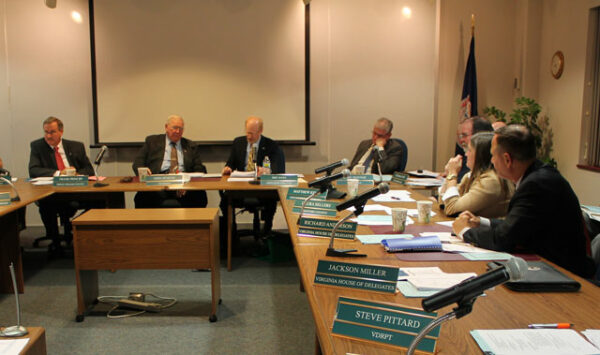
There’s a lot of hope in the newly approved budget put forward Thursday night by the Potomac and Rappahannock Transportation Commission.
Hope that Prince William County will magically find $6 million to help make up some of an annual $9.2 million budget shortfall, every year over the next five years. Hope the Virginia General Assembly will enact a gas tax “floor” to help the agency recoup and additional $3.5 million it lost when gas prices dropped.
If a floor is not found, there’s also hope that Prince William County will make up the entire budget shortfall, each year for the next five years. Prince William County residents are the majority users of the commuter bus service, while the cities of Manassas and Manassas Park don’t pay for the commuter bus service but do have residents that use it.
If those monies don’t come, transit officials spelled out a doomsday scenario. All OmniLink local bus service in Prince William, Manassas, and Manassas Park would end. All OmniRide commuter buses to destinations like Washington, D.C., Arlington, and the Pentagon would be converted to serve only as shuttle buses to area Metro stations.
“If Prince William County doesn’t kick in the $3.5 million, the local bus goes away, commuter buses turn into a Metro feeder bus, and only state-funded services (a bus to Tysons Corner and a new bus to Alexandria’s Mark Center) will continue,” said Eric Marx, PRTC’s interim director.
Overall, gas tax revenues are down about 5% for the year, added Marx.
As bad as it sounds, the budget picture for the flailing transit agency is better than it was. Service cuts, and additional state and federal funding brought down the deficit from $11.5 million annually over the next five years.
A newly increased transit subsidy that gives working federal commuters $255 a month in transit benefits kicked in last month. Those monies also helped to improve PRTC’s financial situation as more commuters are expected to come back to the bus.
The budget will now head to the Prince William County Board of Supervisors, which has been talking about the looming transit crisis since late last year. It has until April to figure out if its got the money needed to fund its portion and keep buses rolling.
PRTC has always relied on funding from the state’s 2.1% motor fuels tax. Fuel prices are predicted to continue to decline, and so will those tax revenues.
After passing landmark transportation reform HB2313 three years ago that raised the state’s sales tax in exchange for $800 million in new transportation funding statewide, it appears state lawmakers are not keen on reopening that discussion.
“Legislators don’t want to open up HB2313,” said Delegate Richard Anderson (R-Prince William). “There’s also talk about establishing a tax floor at current levels, and this is not good news because there is talk gas prices are going to fall even lower,” said Anderson.
A “floor” would mean PRTC would still get the same amount of cash from the state no matter how low fuel prices dip. PRTC had hoped the floor had been established years ago when prices at the pump were higher.
PRTC’s bus budget woes also come at a time when Virginia Railway Express commuter rail service is seeking a 5% increase in funding from member jurisdictions, including Prince William County. The additional money would be set aside in a rainy day fund.
“We have ‘pay as you go’ costs, and we’re losing [train car] storage in Downtown D.C., and we have to replace train cars,” said VRE chief Doug Allen.
Newly installed PRTC Board Chairman Frank Principi said every dollar in increased funding to VRE negatively impacts PRTC.
Also, on the chopping block later this year is PRTC’s Wheels-to-Wellness program that transports riders to and from doctors’ offices. Current sponsor Potomac Health Foundation opted not to fund the service for another year, said Marx.
About $6,000 in donations were given to PRTC from private donors. That money is expected to keep Wheels-to-Wellness up and running for three weeks after regular grant funding runs out.
“We’ve been meeting with Kaiser [Permanente],” said former Prince William County Woodbridge Supervisor Hilda Barg, who also serves on the PRTC Commission. “We want to keep serving the 700 people we are getting to dialysis treatments.”