

By KJ MUSHUNG
Video by
MARY DAVIDSON
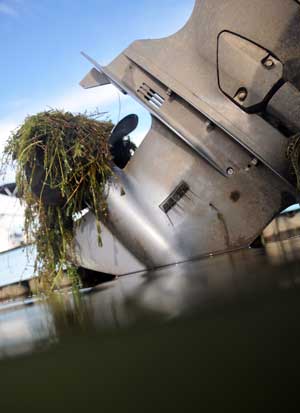
DUMFRIES, Va. — Call it Quantico Bay or Quantico Creek, the Hydrilla is taking over. Hydrilla verticillata is a submerged aquatic weed, and it’s clogging what was once a major port and economic resource.
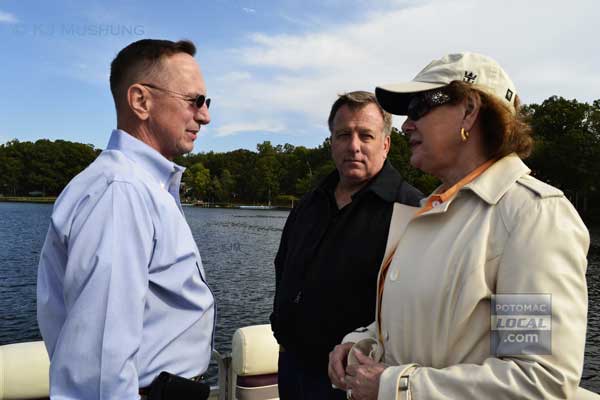
In order to see the extent of the problem, Dumfries Mayor Gerald Foreman, Delegate Mark Dudenhefer (R-2nd, Stafford, Prince William) and Prince William Potomac District Supervisor Maureen S. Caddigan and other officials toured the creek in a pontoon boat on a clear late September morning while the tide was still high.
The tour was arranged by Foreman, Robert and Susan Hart, along with Tony and Eileen Thrall. Eileen Thrall is the head of Friends of Quantico Bay, a local advocacy group. Tony Thrall serves as chairman of the Prince William County Wetlands Board. The Harts own EZ Cruz Marina in Woodbridge.
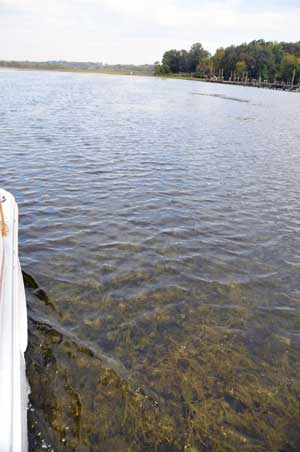
The waterway, seen along Possum Point Road, has been gradually filling up with silt and sub-aquatic vegetation to the point that it’s almost unnavigable by small boats favored by waterfront homeowners. With the amount of Hyrdilla on the rise, the concern is that the creek is disappearing and so is a chance to develop the area economically.
A changing waterway
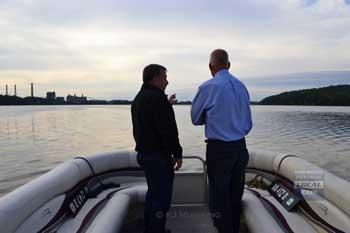
These days the waterway is now known to many as Quantico Creek because it has more characteristics of a creek than a bay.
Eileen Thrall noted that in 1999 only the edges of the creek were covered in Hydrilla, however it’s grown so much since then, especially in the last five years.
Several times during the low-speed boat ride, the boat’s engine overheated trying to cut through the Hydrilla, which could be seen covering the propellers when lifted from the water. Boat traffic can actually aggravate the situation by cutting up the weed, causing it to spread and establish more colonies.
Both Foreman and Former Prince William County Supervisor Hilda Barg (Woodbridge District) noted that people purchase property on the water only to find that they can’t use it the way they intended.
“If the tide gets too low, you can’t go out [on the water] at all,” said Barg.
The weed does more than interfere with boat engines. As sediment runs into the water, instead of passing downstream into the Potomac River, it hits the Hydrilla and settles to the bottom. So the Hydrilla is adding to the buildup of silt on the bay floor.
Once a major port
Dumfries, Va., once rivaled Boston, Philadelphia and New York as having the nation’s leading deep-water port. Its depth went more than 20 feet down in some parts, according to Town Historian Lee Lansing Jr. Now, however, during high tide much of Quantico Bay is only about 4 feet deep and, according to Tony Thrall, its deepest point is around 12 feet, located underneath the railroad bridge near the Possum Point Power Station.
Dumfries was a bustling city in the 1700s. Named after Dumfries, Scotland, it had the nation’s first girl’s finishing school as well as the first interracial school. There were also grist mills, hotels, a theater, a shipyard and, most importantly, the Port of Dumfries in a time when people and goods traveled overseas by boat and the nation was still so young that many goods had to be imported.
The Town of Dumfries was charted in 1749 and is the oldest continuously chartered town in the Commonwealth.
According to a 1998 study by the Prince William County Planning Office, tobacco farmers settled here to be near the town’s tobacco warehouses. Tobacco was usually planted on the waterfront. But the development of these plantations led to the removal of numerous trees and damage to the soil, which lead to erosion and runoff. After a while, ocean vessels could no longer move through the harbor.
Today, part of the town that used to be underwater is now U.S. 1 near Dumfries Town Hall, according to Foreman.
Dredging cost could top $2 million
Officials presented several possible solutions to the problem: Dredging the waterway, harvesting the Hydrilla, using sterile grass carp to eat up the weed or using a chemical herbicide to kill it off.
Clearing the waterway would allow for all sorts of recreational possibilities, Foreman said enthusiastically, adding that the area could have sports fishing, schools could row on the creek and homeowners could use their boats more often.
Most of the officials on the boat favored dredging after seeing how much Hydrilla was in the water and how shallow it was near high tide.
Barg prefers the bay be dredged because the money is better spent since it’s a long-term solution. “Harvesting is a short-term solution, though it’s better than no solution,” she said.
A handout from Friends of Quantico Bay said harvesting the plant can actually spread it if fragments are not contained.
Robert Hart said that dredging is a start in order to get a defined channel. Chemical application would then keep the channel open. “It’s a granular chemical that gets down and sits on the bottom,” he noted.
Hart said he realizes that the word “chemical” has a negative connotation to some people but that it’s being used in a number of places in Florida and other parts of Virginia. However, there still may be environmental concerns given that Quantico Bay is a tributary.
Grass carp, although sterile and therefore unable to reproduce, could swim out into the Potomac River and eat vegetation there instead of in the bay.
According to Foreman, who favors dredging, it will cost approximately $2 million to dredge Quantico Bay and dispose of the sediment. However, one landowner along Possum Point Road reportedly wants to use the sediment as part of a development project. So that, said Foreman, would bring the cost down to $1 million.

Dredging must be partnership
Because the town of Dumfries has only a $4 million annual budget, dredging the bay would be unfeasible for the town alone. “It’s got to be a partnership,” said Foreman. The town, however, could afford to maintain the waterway after it’s been dredged.
But for Eileen Thrall, part of the problem is that “there are too many players in the game.” Dumfries, Prince William County, Marine Corps Base Quantico, Dominion Virginia Power (which owns and operates the Possum Point Power Station) all have property along the water. Add numerous homeowners to that mix and it’s a lot of voices in the debate.
“This has gone on for years,” said Caddigan. “We need to have federal government, state and local working together to come up with a conclusion.”
Caddigan said the projected cost of $1 million to dredge the creek is doable and that when all the agencies work together, it can be done.
“A project like this, from what I’ve seen, they normally try to do it in steps so they don’t have to throw a million [dollars] at it,” said Dudenhefer. “But in this case you can’t just come in and do a little piece of it. You have to do the whole thing… That will make it a little more difficult.”
Foreman is adamant that dredging is the only long-term fix.
“Everything else is a patch. We only have limited resources and don’t have time and resources to do anything twice,” he stated.
Much of the Hydrilla will die off for the winter but be back in the spring. When it dies, it sinks to the bottom with the silt, according to Eileen Thrall.
Economic development aside, some worry that if the waterway is not preserved it’s not going to be there for future generations of river rats. And for those on board that boat who have spent decades on the water, that’s not an option.
Friends of Quantico Bay will meet Thursday, Oct. 11 at 7 p.m., at the Dumfries Community Center, which is the white building next to Dumfries Town Hall. Speakers will include Mayor Foreman, Eileen Thrall and Environmental Engineer Tom Dombrowski.
center>
