

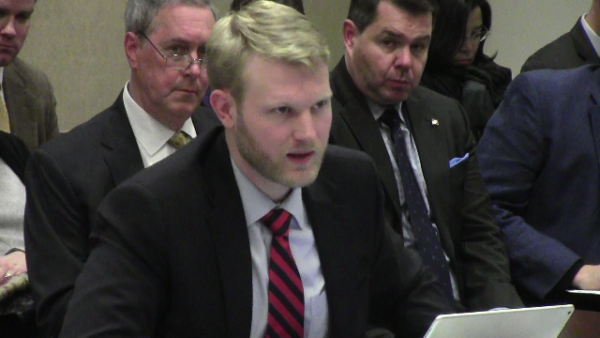
ARLINGTON — At the January meeting of the Northern Virginia Transportation Commission, Ron Meyer, a Loudoun County Supervisor and NVTC Commissioner tried to lobby the commission to demand a change, or if he had his way, a total abolishment of the new tolls on Interstate 66 inside the Captial Beltway.
We reported Virginia Deputy Transportation Secretary Nick Donohue was placed in the hot seat during this same meeting, where he took questions from many commissioners — some who were angry, and some who were confused over the new tolling system, the way it was rolled out in December, and why tolls shot up to as high as $44 for a one-way trip.
Meyer sat next to Donohue and was one of the commissioners who slammed his department that night.
In the end, Donohue told NTVC Commissioners the state heard the concerns of the politicians at the table, but that it had no plans to change or reverse tolling on this portion of the highway. Tolls on I-66 inside the Capital Beltway are needed to ensure a new project to add toll lanes on the same highway outside the Beltway from Dunn Loring west to Gainesville would go off without a hitch, not triggering a “compensation event” where the state would pay the private firms building the I-66 outside the Beltway project.
While Meyer wasn’t successful in his bid to convince the NVTC to pass a resolution condemning the tolls, he did take an opportunity to give the business to the state official at the table, choosing to read multiple, angry emails from drivers in the region sent to Meyer’s email box.
Here’s what Meyer said, and the emails read, taken from a video we shot during the NVTC meeting:
“I want to read a couple things going to constituents across the region. It won’t take long to go through quickly.
Gundee from Ashburn, he says ‘before the toll I left home around 530 a.m. to get to work to make sure I was not violating the HOV rule. Since the hours that changed to 5:30 to 9:30[a.m.] and 3 to 7p.m.. How can I not spend time with my family. I can only use other routes that were worse than before?’
Ed from Broadband says ‘I am one of those people who must drive alone in a personal car every day because my job is a technical marketing and salesperson who works in Downtown D.C. I have a schedule that is never the same day to day. I hope your resolution passed unanimously. I find myself bitterly disappointed the same highway and every business day for 21 years for free is now one usable to me because of the expanded long hours of expensive dynamic tolling.’
Anne from Loudoun says ‘VDOT never indicated that these tolls would get this high. And looking back at past reporting on 66 tolls, it is estimated that tolls will be around $9 at peak.’
Steve from Ashburn says ‘I live in Ashburn and work in the heart of DC. My commute is about 34 miles each day to make to work. My work hours or 6 a.m. to 3:30 p.m. until the recent changes, I was able to get on [I-66] prior to turning it turning to HOV. There’s no way I’m going to pay these outrageous tolls each way and I’m going to have to take alternative routes. For me, it probably means I’ll have an average of 30 minutes of my commute time. And here’s the key thing with.what Steve says, ‘public transportation isn’t a realistic option for me because it takes much longer and results in less time with my family and is far more unpredictable with commute times.’
Colin from Fairfax says ‘thank you for championing reform to the new and terrible I-66 rules. Specifically, returning to the previous hours of free usage that allows so many commuters to work reasonable schedules, arrange for childcare and use highways that our tax dollars built.’
So, you can hear a range of stories there. I just kinda picked a random number from litterally dozens of emails we’ve been getting on this. These are real people’s stories, people that we’re taking the road for free before and following the law. Now there’s three hours of expanded time, as well as those who are wondering why the road is empty and why we aren’t using the capacity that is there.”
