

What Should Go Here?
April 23, 2012 7:50 am - Potomac Local News
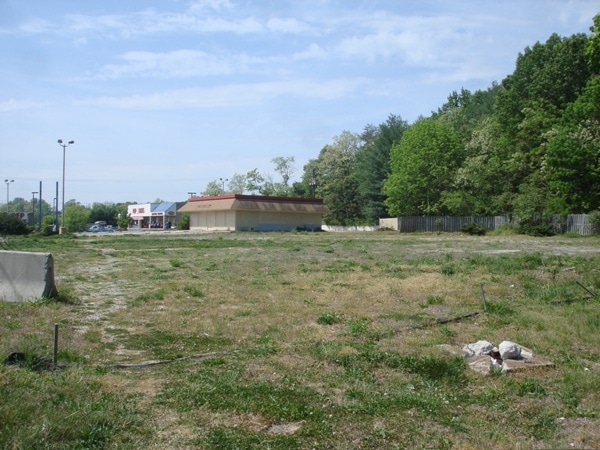
WOODBRIDGE, Va. – At the top of a hill on U.S. 1 in Woodbridge, just past several car dealerships sits an open field and a closed fast food restaurant.
Now boarded up, the Burger King that once served customers along this busy highway has been closed for years. Unlike its counterpart at Tackett’s Mill in Lake Ridge, it shows no sign of coming back.
So, as we continue our series about redeveloping brown spots in the Potomac Communities, we want to know from you “what should go here?”
Please comment below and tell us.


Uriah, here are somethings to consider:
When you have a few minutes, please read this excerpt from Chuck Marohn’s
Strong
Towns
Share it with people who can understand and make a difference in the way we
continue to develop our county:
The Curbside Chat presentation does include a discussion of what we call
“rational responses” — steps we can start to take to respond to the crisis we
find ourselves in. It is a cursory discussion — the companion booklet has a
lot more to say on this — made so because, while there is so much to do, the
Chat can only go on for so long. And I really don’t feel like I can skip over
any of that unblinking part.
As the Strong Towns movement continues to mature, we seem to be in need of,
if not the silver bullet (a concept of gimmickry I categorically reject), then
some conceptual strategies to help public officials pivot from their current
course to one that builds their financial resiliency. To that end, we offer the
following:
1. Stop.
Our system of development has an incredible about of inertia. Here in Memphis
they recently approved a long term transportation plan that is projected to
spend $10 billion, $8 billion of which is reportedly for new capacity. Those
projects are working their way through the system, from initial design to
right-of-way acquisition to final design, bidding and then construction. This
process takes a long time. While it is happening, the market starts to
anticipate the changes, purchasing property and making investments to capitalize
on the improvements. All of this creates a situation that is very hard to
stop.
But stop we must.
In nearly every situation I have encountered, local officials should place an
immediate freeze on new capital improvement projects until they can do a full
return-on-investment analysis. This is a really difficult first step, but a
necessary one. This is a New Economy.
At the end of the railroad expansion era (think Long Depression of the
1870′s), privately-held railroads didn’t go on building more unproductive
lines just because they were part of their plan. They had to react more quickly
to the dramatic change going on around them and so they scrapped those plans,
sometimes halfway through building a line. Our local governments need to be bold
and do the same. Continuing to make unproductive investments with scarce public
resources is an approach we simply can’t afford.
2. Take stock.
Every community needs what we call a REAL Capital Improvements Plan.
What most communities have for a CIP is a wish list of projects they are looking
to do. These projects become the focal point for public officials and the
yardstick by which “progress” is defined, even though they are simply a
manifestation of the system’s inertia.
Instead of a wish list of projects, here is what a real CIP contains:
A list of all infrastructure that a community is obligated to obtain.
An estimate of the remaining useful life of that infrastructure.
An estimate of the cost of repairs when that useful life is concluded.
The corresponding value created or served by the improvement.
For that fourth component, this is relatively simple to compute for
underground infrastructure. For transportation systems, there needs to be a
delineation of streets (where value capture can be measured) and roads (where
traditional measures of mobility enhancements may come into play). As a default
STROADS should be counted as streets unless there is a plan to close access and
increase travel speeds.
Once the community has this list together — which, when you stop and think
of it, is an obvious baseline analysis that every responsible city that is
planning to spend millions should already have (but rarely do) — you can
compare the financial obligations the city has to the revenue stream available
to the community. At this point, the idea of expansion will become ludicrous.
This is why “stop” was the first step; at this point you’ll be glad you did.
3. Start triage.
The Red Cross pioneered the difficult concept of triage on the battlefield.
They developed objective criteria that assisted medics in making the most
difficult choice a person can ever make when confronted with enormous problems
but limited resources: a decision on who lives and who dies. While we face
nothing of this magnitude at the local level, we nonetheless have some really
difficult choices.
I’m not going to pretend to know what the value system we should apply is. I
suspect it will be different based on regional values and preferences. As a
start, let me suggest the following:
Projects that have a positive REAL return on investment. Projects
where the city gets back more cash than is invested should be a no-brainer.
(Note: Don’t use the fraud
of modern engineering economics to determine ROI. Insist on a real
measurement of cash in and cash out.)
Projects where the value of the adjacent tax base can be improved during the
next life cycle so that the segment of infrastructure eventually becomes
self-sustaining.
Projects that provide critical, high-capacity connections between the places
served in #1 and #2.
Others.
Ultimately, a successful project list will identify high value projects that
the public will invest in as well as others that rely on value capture for their
financing and yet others that will need some type of user charge, downsizing,
privatization or even abandonment.
4. Commit to always add value.
Once we’re back to doing projects, there is a simple mantra that needs to be
part of the conversation for every dollar spent on capital improvements: Always Add Value. Especially for
cities that get their money from property taxes, every project needs to be
analyzed for ways to improve the adjacent tax base. And don’t be fooled into
thinking we’re talking about ways to get that WalMart or drive through
restaurant. Those
are not high productivity returns. What we’re talking about, for the next
generation at least, is going to be reactivating lost value.
In the New Economy, capital spending needs to result in increased capturable
value. It is okay to have other objectives as well — social justice, reducing
congestion, job creation, etc… — but it is not difficult to make sure that
your projects Always Add
Value.
5. Reorient your systems.
Finally, to sustain these efforts, local government needs to reorient itself.
For sixty years, local systems have coalesced around inducing growth and
perpetuating the suburban development pattern. All departments of government
have seemingly been oriented in support of this objective. Reorienting these
complex systems is going to take leadership, focus and time.
The local engineering department needs to change from an objective of moving
automobiles to one of Always Add
Value.
The planning department needs to change from an objective of obsessing over
parking, setbacks and green space to one of Always Add Value.
The housing authority, the parks department, the transit service, etc., etc.,
etc…. all need to adopt the mantra Always Add Value.
Our From the Mayor’s Office series spells out, using a speech from a
fictional mayor to his fictional staff, how each department can accomplish this
transition.
Part
1: City Engineer, City Planner
Part
2: Economic Development Director, Parks and Recreation Director, Housing
Rehabilitation Agency Director, Transit Coordinator
Part
3: Public Safety Coordinator, Public Utilities Supervisor, Maintenance
Supervisor, School District Superintendent, Religious Leader, Council of Local
Non-Profits, State Legislator
Remember: leadership, focus and time. Change is difficult, especially in
government where a new idea is often seen as a threat to existing staff and
programs. There is an entire generation of good, decent, hard working public
servants that experienced that initial success from the Suburban Experiment (we
call it the Illusion of Prosperity). It is natural for them to be
resistant to change.
But change we must. Leadership, focus and time will help you create a system
of local government that is obsessed with creating and sustaining value for
residents. This is how places will prosper in the New Economy.
This is how you can build a Strong Town.
Trees.
Bojangles! :)
maybe a dog park.
Please bring a Trader Joe’s to Woodbridge ! Tell me who I need to bribe/beg/whatever it takes !
I had a feeling the Trader Joes crowd would show up sooner or later. It would be great to have one, but the company seems skiddish about coming to the area. They recently passed over Fredericksburg, opting not occupy an old Borders store.
Sonics!!!
An organized day-laborer hub.
SONIC, Greatest place ever.